In response to the humanitarian crisis created by the war in Ukraine, the Clubhouse International Ukraine Fund was established for the global Clubhouse community to come together and support our colleagues who are on the front lines trying to meet the needs of refugees with a mental illness.
We are pleased to say that we exceeded our goal, raising a total of $30,300. This successful campaign was recently featured in Business Insider; click here to view the article!
Seed funding totaling $11,000 was generously provided by members of the Clubhouse International Board of Directors, as well as a match.
Thank you to everyone who helped make this support possible. Together, we are demonstrating the power and love of the Clubhouse community towards our colleagues in Poland and the people of Ukraine. Now, more than ever, mental health care should be accessible to anyone in need.
What the Clubhouse International Ukraine Fund is Providing
Prior to the war, Clubhouse International had been in communication with individuals in Ukraine interested in starting a Clubhouse, and we are continuing our efforts to support the group.
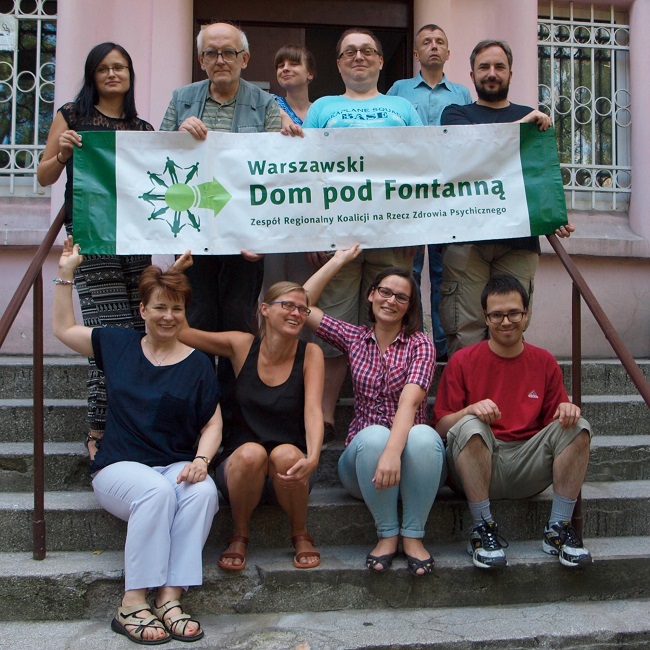
Our immediate need is to support Warszawski Dom pod Fontanna, an Accredited Clubhouse located in Warsaw, in their work to meet the needs of Ukrainian refugees who have experienced a mental illness.
The numbers are overwhelming.
With support from the Clubhouse International Ukraine Fund, Clubhouse colleagues in Poland are working to:
Produce a brochure, translated into Ukrainian, to be widely distributed among refugee centers which will share existing resources for people living with a serious mental illness, including psychiatric and pharmaceutical as well as therapeutic needs.
Provide translation services for those refugees seeking access to mental health support, community and related recovery services at the Clubhouse.
Ensure Clubhouse space is available, not just for individual refugees seeking Clubhouse services but also for self-help groups, translation support, networking, and community support services in helping refugees navigate local existing local services.
We are working closely with leadership on the ground in Warsaw (at the Clubhouse and local agencies) to meet the needs of people living with mental illness even as this humanitarian crisis unfolds. The numbers of refugees, and their needs, grow daily.
Warszawski Dom pod Fontanna, an Accredited Clubhouse located in Warsaw, is working to help Ukrainian refugees.
Clubhouse International Partners with Fountain House to Launch Healing Minds, Powering Communities Campaign
Clubhouse International, in partnership with Fountain House (NY, USA) and other US advocacy organizations, has launched a multi-year US National Advocacy and Awareness Campaign, Healing Minds, Powering Communities,to effect policy change, increase public funding and expand access to proven, community-based solutions such as the Clubhouse Model of psychosocial rehabilitation. Click here to view our press release.
To kick off the campaign, we’re planning a Community Mental Health Week of Action for the week of May 24-31, where participating Clubhouses will open their doors to elected officials, community leaders and members of their local media to show them why the Clubhouse Model works, and to tell them why we need policies supporting psychosocial rehabilitation and funding for mental health.
Research Reveals ‘Mental Health’ as Priority Issue for Voters
Fountain House (NY, USA) spearheaded a bipartisan research project which demonstrates that an overwhelming majority of voters across partisan lines support increasing funding for programs that address serious mental illness (SMI).
The national survey, focus groups, and stakeholder interviews — conducted by Lake Research Partners, Black Raspberry Consumer Insights, and Chesapeake Beach Consulting — sought to gauge what Americans think about mental health care and its electoral impact.
Findings show that voters support increasing funding for programs that address serious mental illness and understand that stigma plays an outsized role in the lack of policy and programs to support people living with mental illness. Click here for more information on the national survey.
“Clubhouse International is committed to continuing to lead in the effort of providing accessible recovery opportunities to anyone with lived experience of a mental illness by integrating the Clubhouse approach into health systems around the world,” said Joel D. Corcoran, Executive Director and CEO of Clubhouse International. “We are proud to partner in bringing the Healing Minds, Powering Communities advocacy campaign to the U.S.-based Clubhouses to effect policy change that prioritizes person-centered mental health care, and to increase funding for mental health services, such as the Clubhouse Model. This campaign will be instrumental in helping Clubhouses to advocate for their programs. The recent bipartisan research is an important validation for the Clubhouse network and supports what we see every day, that communities benefit from having a Clubhouse. Our vision is that one day there is a Clubhouse in every community.”
We are proud to partner in this multi-year, collaborative effort to leverage the voice of lived experience; to advocate for community-based approaches to addressing serious mental illness; to expand access to proven interventions and preventative measures; and grow and sustain a movement that reduces stigma and discrimination for people living with SMI.
We are very excited to share in this campaign and look forward to our collective action!
CEO Joel D. Corcoran Featured on PBS Broadcast During Mental Health Month
The eighth season of Healthy Minds with Dr. Jeffrey Borenstein debuts nationally during Mental Health Awareness Month in May, and will feature Clubhouse International Executive Director and CEO, Joel D. Corcoran. Watch the video below!
This new season of Healthy Minds includes 13 new half-hour episodes, featuring inspiring personal stories of people living with mental illness and experts who share insightful information on a variety of topics in mental health, including new approaches to mental health care.
Mr. Corcoran speaks with Dr. Borenstein about the work of Clubhouse International providing accessible recovery opportunities for people living with mental illness around the world by integrating the Clubhouse Model into community-based systems of care. The episode explores the unique strengths of the Clubhouse Model which is designed to give people living with mental illness what they need beyond medication and therapy: help securing jobs, education, housing, a safe space to find community, and more; and a place where they can also give back to help others.
“Today there is increased openness to discussing mental health, however stigma and misunderstanding remain prevalent and still often keep people from seeking help for themselves or their loved ones,” says Jeffrey Borenstein, M.D., President and CEO of the Brain & Behavior Research Foundation. Dr. Borenstein, who developed the series and serves as its host and executive producer, adds, “Healthy Minds inspires conversations about mental illness, provides understandable information and resources for viewers, and demonstrates that with help, there is hope.”
Clubhouse International is pleased to be featured alongside other leading mental health organizations, such as National Alliance on Mental Illness (NAMI), the Headstrong Project and American Foundation for Suicide Prevention; and leaders such as, Kay Redfield Jamison, Ph.D.
When I first heard about Genesis Club, I didn’t want anything to do with it. I was a rebel back then. But I also realized I wasn’t getting anywhere in my life. I wanted to get back to work so I interviewed for a transitional employment (TE) job at the Department of Mental Health. It was wonderful. I liked the people I worked with and felt like I was needed. I wasn’t sure I could work full-time while managing all of my mental health and doctor’s appointments. But slowly I began to feel more confident. After securing a job and an apartment, the stability I felt didn’t last long. I woke up one night to some noise and saw a fire truck ladder leaning against my building. I had to escape because the building was on fire. I worked with my case manager at the Department of Mental Health to find a new apartment and collect my things that hadn’t been consumed by the flames.
Genesis Club helped me move into my new apartment. They have been like a family to me. When I landed on my feet after the fire, I started in another TE position at Saint Gobain, helping to run the company store when COVID hit. The store had to close due to the pandemic. So I worked with Genesis Club and we found a job at JYL Transportation Company. The recruiter met me at Genesis Club for the interview. I knew my friends and the staff in the unit were there supporting me through the process.
Not too many people can say they love going to work in the morning. I can. I think I actually found my dream job! I help to monitor children going to and from school, and make sure they get there safely. I love knowing I have some place that is expecting me. I love coming home after work to my own apartment. I’m even playing my bass guitar again. And I know if I hit hard times, or if my symptoms get to be too much, folks at Genesis Club will have my back.
We who have felt bad or feel bad are not left out.
I was sick and unwell. Stayed at Sankt Göran for 2 months. Administrator via the Social Services suggested Fountain House. I wanted to get out in the community. The first time I came for a new visit and I was warmly welcomed by Jackie and Elin. I felt it was a place for me. I started coming almost every day and became a member from February 2019. When I arrived I started in the office. The tasks I did were bulletin, statistics and I was part of the young adult group. This summer I went on many excursions. Through all this I have evolved.
Through all this I have evolved.
When I got to the clubhouse, I felt safe and I wanted to work. Over time, I realized that I was getting better and better. I then chose to start at the job market to be able to apply for different jobs and at the same time I came to the house. I told the supervisor on the way out that I wanted to go to work. I received help and support from supervisors and members. Members came up with various tips on jobs.
FH does something nice for one’s personal development.
Today I work at a nursing home and I got the job through Robin, a member of the house. I enjoy my new job, but when I have time I visit Fountain House to hang out with members and supervisors. In this way, I regained my self-confidence and myself. Today I am the person I once was and like it a lot. I am the one who wants to work, get a family, be happy and fight every day. I want to give something back to society and I am doing it right now. With each passing day, I get stronger.
I received a warm welcome.
I want to tell others about Fountain House. It is a special place that does something nice for one’s personal development. You get closer to the community in a safe way by being a member of Fountain House. We who have felt bad or feel bad are not left out, but there is a place for us. I have met amazing people. I got to know members and supervisors as well as the manager who are incredibly nice. Fountain House is a place for everyone who feels that they have mental illness.
I have been dealing with mental illness and anxiety most of my life. It effected my concentration and my ability to be social. I hated school and I couldn’t hold a job. I was finally diagnosed with bi-polar and depression in my early to mid 20s. I self-medicated, becoming an alcoholic and drug addict. Life has been a rollercoaster, one minute I’m up and the next I’m down. It was hard for me to have relationships, it impacted my family tremendously. I’ve been in and out of mental health care for the last twenty years. My whole support team recommended Clubhouse to me and we talked about it for a long time.
Last year I finally had to try and come in. My life was very chaotic and I was tired of being lonely and not having a life. The first time I walked through the doors I had a complete panic attack. I walked in talked with [Clubhouse Director] Rich Meyer and walked out shaking like a leaf, I was way outside my comfort zone. About a month later I worked up the gumption to come in again. I observed and watched and slowly moved past my anxiety. Rich really made me feel welcome, like I was needed and part of something.
Now, I have done a 180-degree turnaround. My social skills are better and I am getting more involved with the Clubhouse. I am working on my sobriety and looking forward to starting work again. I would recommend this place to anyone who has mental health issues. I have seen this place do wonders for myself and others.