

International Standards
The International Standards for Clubhouse Programs™, agreed upon by all our member Clubhouses, define the Clubhouse Model of psychosocial rehabilitation.
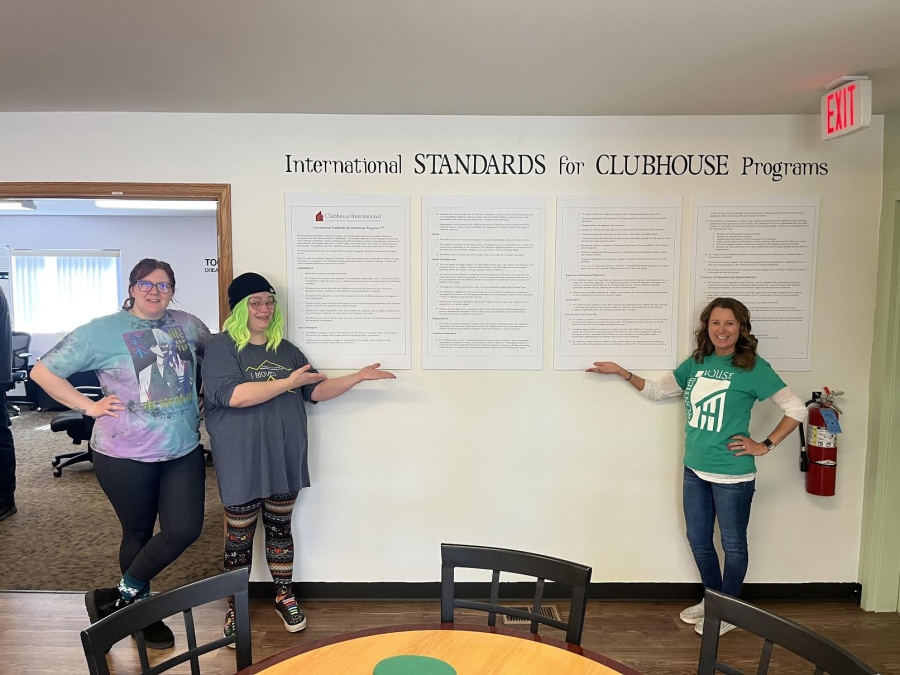
The Standards
- Are at the heart of the success experienced by Clubhouses around the world helping people with mental illness stay out of hospitals while achieving social, financial, educational, and vocational goals;
- Serve as a “bill of rights” for members and a code of ethics for Clubhouse staff, boards and administrators, and a reminder that Clubhouses must be places that offer respect and opportunities to members;
- Provide the basis for assessing Clubhouse quality through the Clubhouse International Accreditation™ process.
- Every two years the worldwide Clubhouse community reviews these Standards and amends them as necessary. The process is coordinated by the Clubhouse International Standards Review Committee, made up of members and staff from Accredited Clubhouses around the world. The Standards insist that a Clubhouse is a place that offers respect and opportunity to its members.
International Standards for Clubhouse Programs
1. Membership is voluntary and without time limits.
2. The Clubhouse has control over its acceptance of new members. Membership is open to anyone with a history of mental illness, unless that person poses a significant and current threat to the general safety of the Clubhouse community.
3. Members choose the way they utilize the Clubhouse, and the staff with whom they work. There are no agreements, contracts, schedules, or rules intended to enforce participation of members.
4. The Clubhouse community promotes acceptance and inclusion. All members have access to every Clubhouse
opportunity.
5. Members at their choice are involved in the writing of all records reflecting their participation in the Clubhouse. All such records are to be signed by both member and staff.
6. Members have a right to immediate re-entry into the Clubhouse community after any length of absence, unless their return poses a significant and current threat to the Clubhouse community.
7. The Clubhouse provides an effective reach out system to members who are not attending, becoming isolated in the community or hospitalized.
8. All Clubhouse meetings are open to both members and staff. There are no formal member only meetings or formal staff only meetings where program decisions and member issues are discussed.
9. Clubhouse staff are sufficient to engage the membership, yet few enough to make carrying out their responsibilities impossible without member involvement.
10. Clubhouse staff have generalist roles. All staff share employment, housing, evening and weekend, holiday and unit responsibilities. Clubhouse staff do not divide their time between Clubhouse and other major work responsibilities that conflict with the unique nature of member/staff relationships.
11. Responsibility for the operation of the Clubhouse lies with the members and staff and ultimately with the Clubhouse director. Central to this responsibility is the engagement of members and staff in all aspects of Clubhouse operation.
12 The Clubhouse has its own identity, including its own name, mailing address, email and telephone number.
13. The Clubhouse is located in its own physical space. It is separate from any mental health center or institutional settings, and is impermeable to other programs. The Clubhouse is designed to facilitate the work-ordered day and at the same time be attractive, adequate in size, and convey a sense of respect and dignity.
14. All Clubhouse space is member and staff accessible. There are no staff only or member only spaces.
15. The work-ordered day engages members and staff together, side-by-side, in the running of the Clubhouse. The Clubhouse focuses on strengths, talents and abilities; therefore, the work-ordered day must not include medication clinics, day treatment or therapy programs within the Clubhouse.
16. The work done in the Clubhouse is exclusively the work generated by the Clubhouse in the operation and enhancement of the Clubhouse community. No work for outside individuals or agencies, whether for pay or not, is acceptable work in the Clubhouse. Members are not paid for any Clubhouse work, nor are there any artificial reward systems.
17. The Clubhouse is open at least five days a week. The work-ordered day parallels typical working hours.
18. The Clubhouse is organized into one or more work units, each of which has sufficient staff, members and meaningful work to sustain a full and engaging work-ordered day. Unit meetings are held to foster relationships as well as to organize and plan the work of the day.
19. All work in the Clubhouse is designed to help members regain self worth, purpose and confidence; it is not intended to be job specific training.
20. Members have the opportunity to participate in all the work of the Clubhouse, including administration, research, enrollment and orientation, reach out, hiring, training and evaluation of staff, public relations, advocacy and evaluation of Clubhouse effectiveness.
21. The Clubhouse enables its members to return to paid work through Transitional Employment, Supported Employment and Independent Employment; therefore, the Clubhouse does not provide employment to members through in-house businesses, segregated Clubhouse enterprises or sheltered workshops.
Transitional Employment
22. The Clubhouse offers its own Transitional Employment program, which provides as a right of membership opportunities for members to work on job placements in the labor market. As a defining characteristic of a Clubhouse Transitional Employment program, the Clubhouse guarantees coverage on all placements during member absences. In addition the Transitional Employment program meets the following basic criteria.
a. The desire to work is the single most important factor determining placement opportunity.
b. Placement opportunities will continue to be available regardless of the level of success in previous placements.
c. Members work at the employer’s place of business.
d. Members are paid the prevailing wage rate, but at least minimum wage, directly by the employer.
e. Transitional Employment placements are drawn from a wide variety of job opportunities.
f. Transitional Employment placements are part-time and time-limited, generally 12 to 20 hours per week and from six to nine months in duration.
g. Selection and training of members on Transitional Employment is the responsibility of the Clubhouse, not the employer.
h. Clubhouse members and staff prepare reports on TE placements for all appropriate agencies dealing with members’ benefits.
i. Transitional Employment placements are managed by Clubhouse staff and members and not by TE specialists.
j. There are no TE placements within the Clubhouse. Transitional Employment placements at an auspice agency must be off site from the Clubhouse and meet all of the above criteria.
Supported and Independent Employment
23. The Clubhouse offers its own Supported and Independent Employment Programs to assist members to secure, sustain, and better their employment. As a defining characteristic of Clubhouse Supported Employment, the Clubhouse maintains a relationship with the working member and the employer. Members and staff in partnership determine the type, frequency and location of desired supports.
24. Members who are working independently continue to have available all Clubhouse supports and opportunities as well as participation in evening and weekend programs.
25. The Clubhouse assists members to reach their vocational and educational goals by helping them take advantage of educational opportunities in the community. When the Clubhouse also provides an in-house education program, it significantly utilizes the teaching and tutoring skills of members.
26. The Clubhouse is located in an area where access to local transportation can be assured, both in terms of getting to and from the program and accessing TE opportunities. The Clubhouse provides or arranges for effective alternatives whenever access to public transportation is limited.
27. Community support services are provided by members and staff of the Clubhouse. Community support activities are centered in the work unit structure of the Clubhouse. They include helping with entitlements, housing and advocacy, promoting healthy lifestyles, as well as assistance in accessing quality medical, psychological, pharmacological and substance abuse services in the community.
28. The Clubhouse provides assistance designed to help members improve their physical health and wellness, in partnership with community-based resources and healthcare providers. If the Clubhouse also provides in-house wellness activities, they are scheduled to be consistent with a vibrant, side-by-side work-ordered day; and significantly utilize the teaching skills and expertise of members.
29. The Clubhouse is committed to securing a range of choices of safe, decent and affordable housing including independent living opportunities for all members. The Clubhouse has access to opportunities that meet these criteria, or if unavailable, the Clubhouse develops its own housing program. Clubhouse housing programs meet the following basic criteria.
- Members and staff manage the program together.
- Members who live there do so by choice.
- Members choose the location of their housing and their roommates.
- Policies and procedures are developed in a manner consistent with the rest of the Clubhouse culture.
- The level of support increases or decreases in response to the changing needs of the member.
- Members and staff actively reach out to help members keep their housing, especially during periods of hospitalization.
30. On a regular basis the Clubhouse conducts an objective evaluation of its effectiveness, including Clubhouse International Accreditation.
31. The Clubhouse director, members, staff and other appropriate persons participate in a comprehensive two or three week training program in the Clubhouse Model at a certified training base.
32. The Clubhouse has recreational and social programs during evenings and on weekends. Holidays are celebrated on the actual day they are observed.
33. The Clubhouse has an independent board of directors, or if it is affiliated with a sponsoring agency, has a separate advisory board comprised of individuals uniquely positioned to provide financial, legal, legislative, employment development, consumer and community support and advocacy for the Clubhouse.
34. The Clubhouse develops and maintains its own budget, approved by the board or supported by an advisory board, which provides input and recommendations prior to the beginning of the fiscal year and routinely monitors it during the year.
35. Staff salaries are competitive with comparable positions in the mental health field.
36. The Clubhouse has the support of appropriate mental health authorities and all necessary licenses and accreditations. The Clubhouse collaborates with people and organizations that can increase its effectiveness in the broader community.
37. The Clubhouse holds open forums and has procedures which enable members and staff to actively participate in decision making, generally by consensus, regarding governance, policy making, and the future direction and development of the Clubhouse.

|
Download a PDF version of the Standards in Arabic | Download |

|
Download a PDF version of the Standards in Chinese (Traditional) | Download |
|
|
Download a PDF version of the Standards in Chinese (Simplified) | Download |

|
Download a PDF version of the Standards in Danish | Download |

|
Download a PDF version of the Standards in Dutch | Download |

|
Download a PDF version of the Standards in English | Download |

|
Download a PDF version of the Standards in Estonian | Download |

|
Download a PDF version of the Standards in Finnish | Download |

|
Download a PDF version of the Standards in French | Download |

|
Download a PDF version of the Standards in German | Download |

|
Download a PDF version of the Standards in Hebrew | Download |

|
Download a PDF version of the Standards in Hindi | Download |

|
Download a PDF version of the Standards in Italian | Download |

|
Download a PDF version of the Standards in Japanese (Traditional) | Download |
|
|
Download a PDF version of the Standards in Japanese (Three-Fold) | Download |

|
Download a PDF version of the Standards in Korean | Download |

|
Download a PDF version of the Standards in Mongolian | Download |

|
Download a PDF version of the Standards in Norwegian | Download |

|
Download a PDF version of the Standards in Polish | Download |

|
Download a PDF version of the Standards in Russian | Download |

|
Download a PDF version of the Standards in Spanish | Download |

|
Download a PDF version of the Standards in Swedish | Download |
-3.png?resize=630x400)
The Standards Review Committee
The Standards Review Committee (SRC) is made up of members and staff from Accredited Clubhouses who help facilitate the ongoing, biennial review of the International Standards for Clubhouse
Programs™.
The SRC manages the process for collecting and considering proposals for changes to the Standards and works with Clubhouse International staff and the Faculty for Clubhouse Development to
determine the level of consensus for qualified proposals. The SRC does not write, propose, or edit proposals for consideration by the international Clubhouse community.
All member Clubhouses have the opportunity to participate in the Standards review process as a benefit of membership in the Clubhouse International network. This participatory process ensures that the Standards continue to reflect the collective experience and evolving best practices of the international Clubhouse community.
See the Model in Action
Clubhouses are a powerful demonstration that people with mental illness can and do lead productive, fulfilling lives.