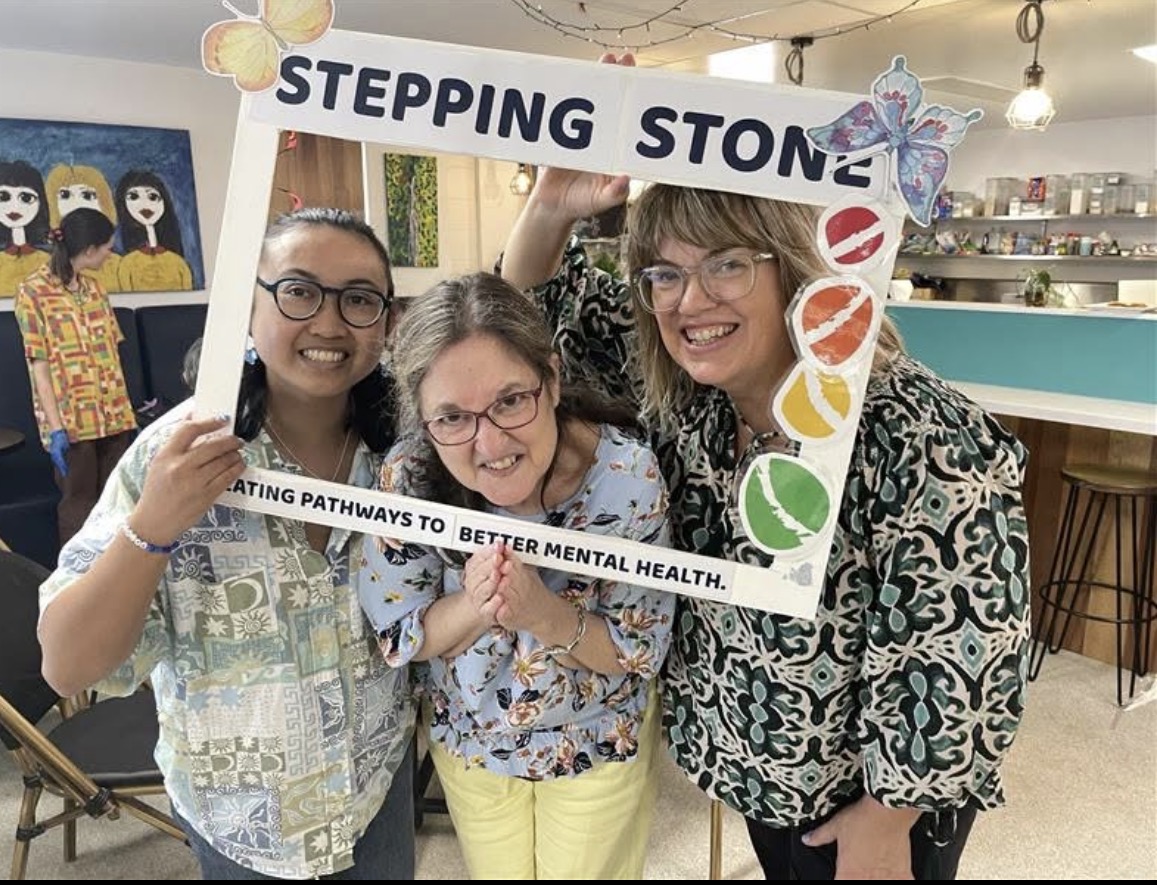
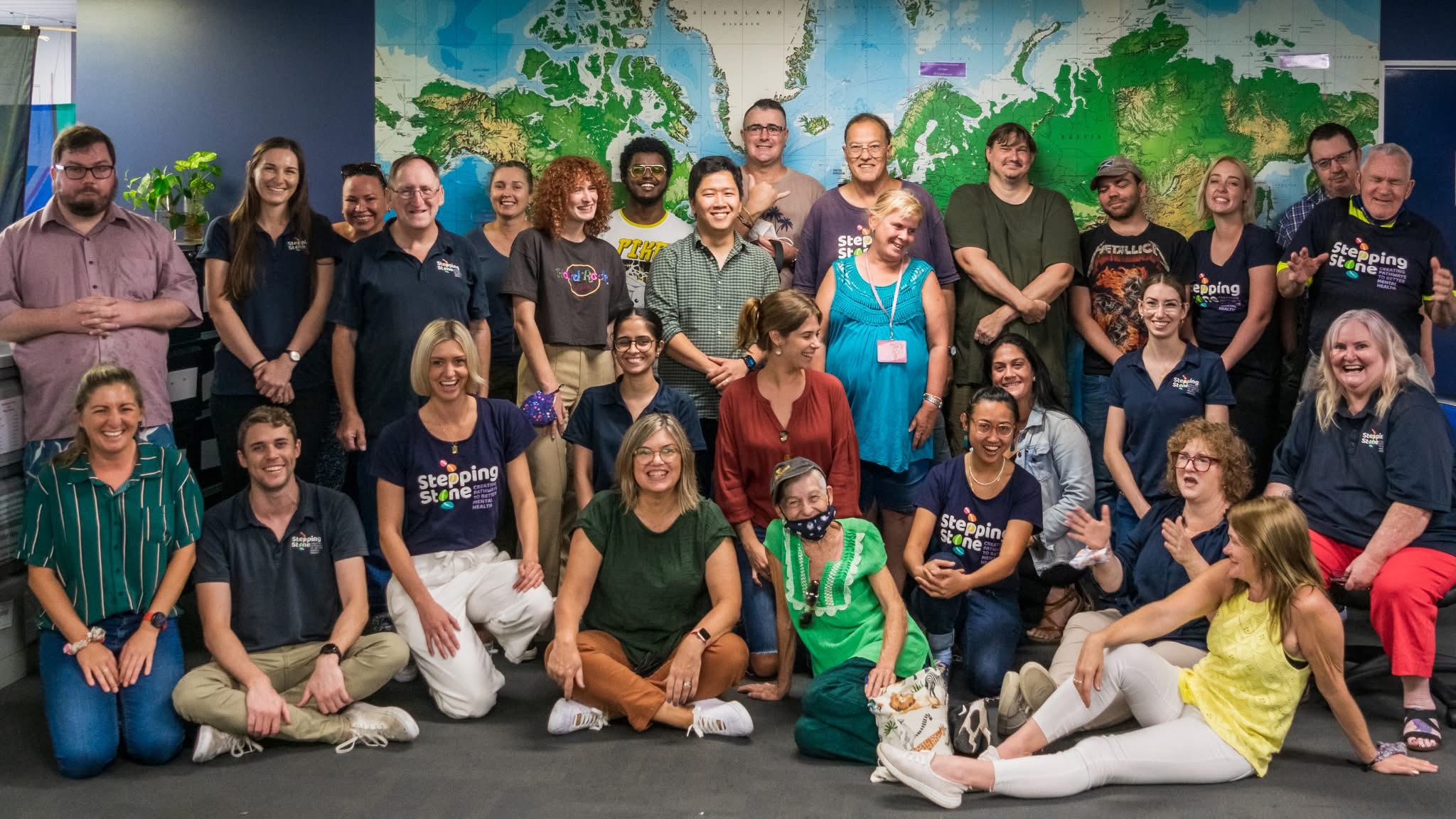
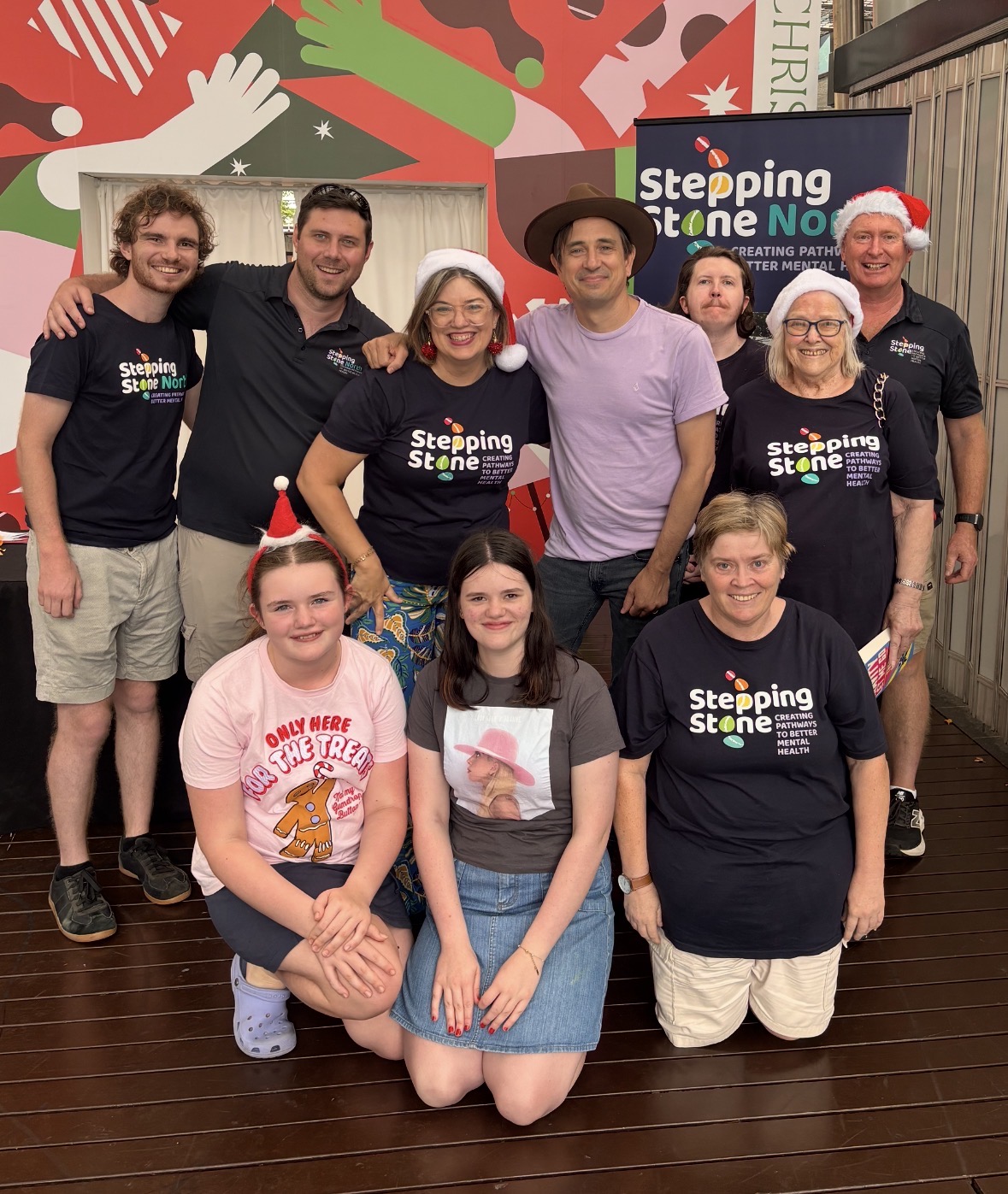
In today’s workforce, it’s common for individuals to hold 12 or more jobs across multiple companies over the course of their careers. It’s the rarity to work at a single place for decades but such is not the case within the Clubhouse world. There is something uniquely powerful about the Clubhouse Model, and the profound impact it has on member’s lives that inspires staff to stay. This is true for Melanie Sennett of Stepping Stone Clubhouse in Brisbane, Australia.
Melanie recalls her experience interviewing at Stepping Stone Clubhouse in 1996. “It did not go well. People told me later that I had bombed the interview. I worked in the kitchen for the day though and that’s when I got to connect with members and ultimately land the job.” That was 30 years ago!
Melanie spent six months in the kitchen unit, then transferred to the clerical unit, moved again to employment coordinator, served as the Director, and eventually became the CEO of the Clubhouse. “It’s really been like forty different jobs in one place. In the beginning we had few staff and even less money and I took on the challenge of increasing funds and the Clubhouse began to grow.”
In the past three decades Melanie and the clubhouse community have grown the Clubhouse’s physical footprint and membership. In 2024 Stepping Stone Clubhouse expanded, opening a second location in a northern suburb of Brisbane. Between the two Clubhouses there are now 4,000 members.
While growing Stepping Stone Clubhouse has been rewarding, one of the highlights of Melanie’s career is helping train the first Clubhouse to open its doors in mainland China. Stepping Stone Clubhouse is one of Clubhouse International’s 12 training centers across the globe. “The Chinese team came for a two week training at Stepping Stone Clubhouse and we organised student translators. Afterwards we traveled to China to visit Heart Wing Clubhouse and members continued to come up to us, thanking our team. The experience changed my life and gave me such hope.”
The impact the Clubhouse Model has on members is the reason Melanie has stayed at her job for so long. “When a member comes to us feeling broken and tells me they will never work again, I think– just you wait. Trust in us, we will be your cheerleader just give it time and let the Clubhouse magic happen. They don’t believe it will happen but through the work inside the Clubhouse they find employment, friendship, housing– some even have clubhouse weddings. I’ve seen it over and over again and it’s such a privilege to witness their recovery.”
Melanie says what’s amazing is that members who have recovered are invested in helping fellow members move forward in their own recovery journey, creating a powerful cycle of support that defines the Clubhouse community.“It’s organic and just happens. Members know what it feels like to walk through the doors for the first time and they want to help. It’s one of the beautiful things about our Model and community.”
And Melanie plans to be part of it until she retires. “Why would I leave? I can’t do interviews so I’m stuck!” Jokes aside, her transformational work at Stepping Stone Clubhouse is not complete. She says the Stepping Stone name was created by members and the logo with five stepping stones signifies different parts of each member’s journey. Some stones might be wet and slippery, others might be misaligned but when you put them all together you get a stable path. For Melanie, the five stones in their logo now also represent the number of Clubhouses she dreams of opening. “My board and I are ambitious and I tell myself I have three more Clubhouses to open before I call it quits or we could just add more stones!” More Clubhouses equals more members served and more hope, rehabilitation and recovery realized.
“People deserve this, to be part of something that allows them to move past the trauma of their mental health, recover from it and go on to live a great life.”
We couldn’t agree more. Interested in discovering the Clubhouse difference for yourself or a loved one? Visit our directory to see if there is an existing Clubhouse in your community or learn more about how to start one.
A Mother’s Gratitude for the Healing Impact of Clubhouse
When you’ve watched your child grow and nurtured them, you have dreams for a bright future. That’s what makes a mental illness diagnosis so hard for a parent to hear. But there is always hope!
Christine watched her son unravel when he was just 14-years of age, a time that should have been filled with momentum and possibility. Instead, it was marked by a devastating breakdown and a mental illness diagnosis that left their family reeling. With a mother’s love and dedication, Christine poured compassion, energy, time, and determination into finding help. Despite this, life became a cycle of hospital stays and fragile recoveries. Each time her son came home, he seemed more discouraged. Christine saw what others often couldn’t, a bright, capable young man with dreams and potential, who hadn’t yet found the right kind of support. Her son was tired of being a “patient”, tired of feeling defined by his illness. What he wanted was simply to be independent, to work, and to belong.
Finally two years ago, Christine was thrilled when her son shared that he had found a new community resource, Clubhouse Nantes, in France. Christine stayed behind the scenes, gently encouraging her son while understanding that he needed to find his own way. He was hesitant and anxious at first, afraid of yet another program that might not help, but when he finally gained the courage to walk through the doors, he found something unexpected – not a clinic, but a community. There were people working side-by-side, preparing meals, writing newsletters, answering phones. At the Clubhouse, he was treated as a person, not a diagnosis. He began contributing, meeting others, and slowly rebuilding his confidence. He eventually found gainful employment!
Today, Christine sees the difference in her son: pride in his work, purpose in his days, and belief in himself. For the first time in years, he knows he belongs, and that has changed everything including Christine’s outlook for his future. She sees how Clubhouse has restored him and given her son direction and purpose.
Not a lot of people work at the same place for 40 years. Even more rare is to have a career dedicated to helping others. When Jennifer Higginbotham leaves Independence Center in St. Louis, Missouri in the summer of 2026, she will undoubtedly leave behind a legacy of true impact. Countless lives have been touched and potentially saved because of her compassionate work to help those living with serious mental illness.
Jennifer recently shared her long Clubhouse career journey, but interestingly she did not sound like a woman slowing down into retirement. She is raring to go! Jennifer speaks about Clubhouse with the same passion she describes having for it when she took her first tour of Independence Center in 1985. “My college advisor recommended I visit the Clubhouse and a member named Buddy gave me my first tour. I was sold the moment I walked in the door.”
Jennifer was finishing her master’s degree in social work at the time and was so enamored with the Clubhouse Model that she asked Independence Center if she could do a second internship during her final semester and the Clubhouse obliged. Fast forward a few months, she was hired after graduation in 1986 and never left!
Jennifer has worn many hats at Independence Center throughout the decades. She was a unit leader, a housing director, a Clubhouse director, and in 2007 led an initiative to combine the center’s urban and suburban Clubhouses into one. Additionally, amongst many boards and committees at Clubhouse International, she served on the Clubhouse International Faculty for 20 years where she worked with other Clubhouse members and staff to accredit Clubhouses around the world as part of the critical, and unique, Clubhouse quality assurance process. More recently Jennifer has held the position of Independence Center’s Chief Program Officer, providing numerous wrap-around services to members.
It’s been 19 years since Independence Center consolidated Clubhouses, but Jennifer recalls this favorite Clubhouse memory like it was yesterday. “I remember standing with members, staff and our architect; deciding where our units would be placed inside this 50k square foot building that used to be a rag factory. We were not just moving physical Clubhouses, we were combining cultures and personalities. On move in day the environment was electric, I was doing tours and communicating with the team while watching our collective vision become a reality.”
Jennifer says she has stayed at the same place for so long because of the mission, community and the relationships she has formed over four decades. “I wanted to help people living with serious mental illness, but I fell in love with the philosophy of the Clubhouse Model from the start.” The Clubhouse ethos espouses that we all need: community, purpose, belonging, and a place to go where you feel needed, wanted and expected. As much as Jennifer has given to members of Clubhouse she has received so much more in return. “This is my community too, my kids grew up alongside me in the Clubhouse and it’s always felt like home.”
In 40 years, she has meant so much to so many, but several members have personally touched Jennifer’s heart. “I could tear up right now just thinking about Mary. She was my right hand and the matriarch of this Clubhouse and did everything from driving our van to making the best applesauce cake ever. She loved working in the kitchen. Mary was here in the early days, I knew her for 20 years and was honored to eulogize her at her funeral in 2019.” There are others like the member who partnered with Jennifer so they both could kick their smoking habits. “Mimi and I would check in with each other every morning, holding each other accountable to not smoke. We’ve both been smoke-free for 20 years!” Jennifer also recalls a member who was incredibly reluctant to even attend the Clubhouse. When staff finally got him settled in, they encouraged him to try transitional employment. He resisted for the longest time but finally relented. “He got his start giving tours at our Clubhouse and for the past 13 years he’s been a tour guide at the St. Louis Gateway Arch!”
Jennifer knows she stands on the shoulders of the giants responsible for creating the Clubhouse Model of psychosocial rehabilitation. There are countless people she admires within the movement but when asked for women heroes, the name she mentioned first was Esther Montanez. Esther was the first director of the Fountain House Gallery who is credited with implementing the Work-Ordered Day. “She blew me away. She came for a visit in the 80s and turned our world upside down. She went through our thrift store and told us all the things we were doing wrong and kept us late. She was a force to be reckoned with, and I was impressed and inspired by her.” Another woman giant in the Clubhouse movement Jennifer mentioned is Robby Vorspan, who she describes as the model for Clubhouse. “Everyone loved her and I respected her before I ever met her. I got to know her through the incredible Clubhouse articles she wrote that forwarded our Model and inspired those working within it. She was one of the original thought leaders in the space and through her legacy her important work carries on.”
Other women in the movement Jennifer admires, just to name a few, are:
Lori D’Angelo at Magnolia Clubhouse because of her passion for the Model, she played a major role in merging a community mental health center and an auspice Clubhouse into a freestanding one;
Lisa Soucie at High Hopes Clubhouse in Maine who shares a passion for Clubhouse’s employment program;
Rachel Forman at Grand Avenue Club in Milwaukee is a force in Jennifer’s eyes, the two share a love of art and Clubhouse resale shops;
Chris Habal succeeded Brenda at Progress Place and the two became fast friends at Jennifer’s first International Seminar in Salt Lake City;
She describes Ruth Osterman at Genesis Club as an amazing leader who gave her confidence to be a Faculty Member;
Nancy Emory at Gateway and Kathleen Rhodes previously with Fountain House, both challenged and inspired her love for colleague training;
and Kailey Fiedler-Gohlke in Washington is rocking it at Hero House according to Jennifer; under her leadership Clubhouses have grown from one small one to four across the state.
“All of these women are fire souls who are determined and mission-driven. The founders inspired us, now the next generation is coming, and I see lots of strong leaders. There’s a feeling in the movement that there’s something different in the air and that we are closer to building a community where there are Clubhouses in every neighborhood.”
Clubhouse International is working tirelessly with Clubhouses and coalitions across the globe to make this dream a reality. The Clubhouse movement is stronger because of Jennifer’s decades-long commitment to the Model and those living with serious mental illness. Collectively we all say THANK YOU!
If you know someone that could benefit from Clubhouse psychosocial rehabilitation, visit our website or directory to see if there is a Clubhouse near you.
Clubhouse Model Highlighted in Milken Institute Report on Schizophrenia Care
The Milken Institute published a giving guide focused on schizophrenia care in February 2026. The guide examines both care models and delivery systems and identifies shortcomings in the current care landscape while outlining strategic funding opportunities to improve schizophrenia care.
The Clubhouse Model is mentioned for its effectiveness on page 19 of the report.
The Milken Institute suggests effective treatment should:
address symptoms;
support individuals with schizophrenia as well as their families;
help keep individuals with schizophrenia connected to their communities; and
enable participation in meaningful work, education, or other activities.
While the report calls for comprehensive treatment, it acknowledges barriers to effective care exist and that many individuals do not receive timely treatment, leading to repeated cycles through emergency services, hospitalization, homelessness, and the criminal justice system—at an estimated annual cost of over $300 billion in the United States alone.
There is hope though, despite challenges, the report says momentum for change is building and credits a range of models like Clubhouse for demonstrating success.
The Giving Smarter Guide recommends opportunities to increase access to care while building toward a sustainable, cohesive system.
Canadian Study Finds Clubhouse Reduced Mental Health Hospitalizations by 78%
Results from Canada’s first economic evaluation of the Clubhouse Model are promising according to a study conducted by the University of Toronto in partnership with Progress Place, one of Clubhouse International’s 12 Training Centers and the only Clubhouse currently in Toronto. The study published in February 2026, shows Clubhouse members’ self-reported mental health hospital days were reduced by 78%. Over two years and amongst 101 study participants, hospitalizations went from 1,850 to 407 and generated $87,677 in net health system savings.
The study cites a 2011 source that shows the combined economic costs of mental health disorders and associated erosions in quality of life, healthcare costs, and lost productivity amount to $50 billion per year in Canada. This latest study demonstrates that the Clubhouse Model is not just effective at promoting recovery, it also profoundly reduced healthcare costs.
“This research confirms what the Clubhouse community has known for decades: the Clubhouse Model works. It helps people living with serious mental illness rebuild their lives through community, purpose, and opportunity, while also reducing healthcare costs,” said Joel Corcoran, CEO of Clubhouse International.”
To read the full study click here and to here for accompanying news coverage.
Clubhouse Inspires Teacher to get back in the Classroom
If you were struggling with a physical illness or disease, it’s unlikely it would take you 40 years to seek medical treatment. But when it comes to mental illness, many endure in silence for decades. Such is true for Regina, a high school English teacher in Florida.
“I was raised in a time where you only got help if you really needed it, it was just not the norm at the time. I was not invited to seek help and just lived with it.”
While many people today still do not seek treatment and care, the tide has changed as more and more people are recognizing mental health is health. According to the National Institute of Mental Health, among the 15.4 million adults in the US with serious mental illness in 2022, nearly 67% received treatment. And of those people, a higher percentage of women (71.4%) sought treatment than men (59.3%).
Regina says she always knew she was anxious and had depression. She had seen it in her own home, her mother lived with serious depression. But when it came to her own health, she didn’t really think she needed any help until she was hospitalized for an eating disorder. “I was in my 40s and a doctor told me I needed to be admitted urgently because I only weighed 70 pounds. I kept it from my husband for two days and when I finally told him what the doctor had said, he convinced me to seek treatment.” That was the start of Regina’s road to mental wellness.
As a self-admitted perfectionist, Regina says the hospitalization made her realize she needed to focus on self-care. After spending more than a month at a specialized eating disorder clinic, she knew she had to work on herself full-time, so she made the difficult decision to quit the teaching job she loved.
“I needed to focus on myself, which I had never done before. I had been neglecting my own health for a long time and putting my career and everything else first.”
Her loving husband supported her in her recovery. He was working through a PTSD diagnosis himself and was in treatment. He was keenly aware of the work it took to get one’s mental health on track. Tragically, after 20 years of being her rock, Regina’s husband suddenly suffered a stroke that ultimately took his life. He was only 39 years-old and Regina was now a widow just a few short years after her hospitalization.
Her husband’s death left her alone and unsure of what the future would hold. Regina’s life was in New Jersey but her father who lived in Florida encouraged her to head south. “I was truly thrilled to get the invite to move in with my dad. We had vacationed there when I was a kid and given my situation it was a dream come true. I love it here.”
Florida was the start of a new life, and it was there where Regina discovered Clubhouse. Her therapist recommended The Academy at Glengary in Sarasota as a place where she could find community and purpose.
“I was open minded about it but nervous because I was not sure what I would do there. It turned out to be a good thing. Because of my career as an English teacher, they asked me to do a workshop to teach members how to write a professional email. I did a second workshop on poetry and wellness. This experience was the catalyst for getting me back into teaching.”
Regina is currently an English teacher at a Sarasota High School. She says the students give her hope for the future. “Young people are open minded about mental health and are not judgmental. Many of them have their own diagnoses and live unashamed.”
As for her future, Regina is dating again and is more committed than ever to self-care. “My advice to anyone experiencing anxiety or depression is to not wait to seek treatment. I was always against it and in taking medication, but both have changed my life.”
And through her Clubhouse Regina has learned she is not alone. “What they say at the Academy at Glengary is to be grateful and appreciate every moment. I try to live by that every day!”
Know someone that could benefit from Clubhouse? We have more than 370 locations across the globe and there may be one near you. Visit our directory to learn more.