This year, 44 Clubhouses participated in Clubhouse Giving Day, with over 600 donors coming together to raise more than $193,000 for our joint mission to provide recovery opportunities to people living with mental illness! We are excited to share that we exceeded last year’s total by $42,000!
We celebrated the kick-off of Mental Health Awareness Month with Clubhouse Giving Day on May 1st. This is our own Giving Day dedicated to raising funds and awareness for Clubhouse International and the life-changing work of Clubhouses around the world. We come together at this special time as a global community to support mental health recovery and empower individuals living with mental illness.
We hope you will join us again next year on May 1st!
Why Support Clubhouse Giving Day?
Clubhouse International works to strengthen Clubhouses and support new Clubhouse Development. At the local level, Clubhouses offer people living with mental illness opportunities for community, employment, education and more. At the state, national and international levels, we are working to integrate the Clubhouse Model of psychosocial rehabilitation into community mental health.
No other mental health recovery model has the proven outcomes and no other global organization is structured around the fundamental integration of the voices of lived experience; it is a core principle in all that we do.
We are currently working with nearly 40 startup groups in 13 countries to provide extensive technical consultation and support in addition to our formal New Development Training. In the past 18 months, we have supported 36 Clubhouses joining our network!
Today, the Clubhouse International network includes over 370 Clubhouses in 31 countries. Approximately 110,000 people living with mental illness worldwide have access to a Clubhouse.
Your donation helps:
Expand access to Clubhouses worldwide
Provide meaningful employment, education, and social opportunities
Ensure ongoing support and advocacy for mental health recovery
How you can make a difference:
Donate: Every contribution – big or small – creates lasting change.
Fundraise: Start your own fundraiser and inspire your community to join you.
Spread the word: Share our mission, tell your friends, tag us on social media and use #ClubhouseGivingDay
Clubhouse International World Seminar 2025 has come to a close — what an incredible event!
A tremendous thank you to all of the Clubhouse members, staff, Board of Directors, mental health advocates and stakeholders who participated in Clubhouse International World Seminar 2025. It was a successful five education-packed days covering a wide range of topics that enhance and strengthen each individual Clubhouse as well as the global Clubhouse community.
We had 650 attendees from 16 countries, 32 U.S. states, nearly 170 Clubhouses, and several global mental health organizations.
Thank you very much to our co-host, Florida Clubhouse Coalition!
The Clubhouse International World Seminar aims to showcase the remarkable efforts of our Clubhouse network and provide a platform to strengthen our collective impact. It is the largest gathering of our community, bringing together Clubhouse members, staff, mental health advocates and stakeholders. This event is designed to be the most inclusive global mental health training of its kind!
A Global Movement of Hope: Clubhouse International’s Mental Health Advocacy Initiative 2025
Clubhouse International champions global advocacy to transform mental health care through its 2025 advocacy initiatives.
Advocacy efforts have become more essential and urgent as mental health challenges sweep through continents. These issues are global concerns, as seen from the silent crises in underserved communities to the growing sense of disconnection in wealthier nations. Clubhouse International, a forward-thinking New York-based nonprofit organization, believes collaborative, sustained, and compassionate responses are needed. Hence, it creates platforms rooted in dignity, purpose, and above all, hope.
Established in 1994 with roots in 1948, Clubhouse International has been known for empowering individuals living with mental illness to reclaim their lives through community and connection. Employing the Clubhouse Model, the organization provides safe, inclusive environments where members receive support to build meaningful relationships, pursue education, obtain employment, and access housing and healthcare.
Clubhouse International recognizes how systemic issues affecting mental health care are becoming more severe amid growing uncertainty. Because of the complex landscape, its local Clubhouses are facing challenges that might leave vulnerable populations without access to essential services. This crisis mirrors the global truth that mental health support structures are usually low in priority, making it one of the first to face financial shortfalls despite being integral to societal well-being.
The stigma surrounding mental illness also continues to hinder progress. Clubhouse International offers a vision that shifts away from an underfunded, misunderstood, and invisible landscape. It champions mutual respect and shared humanity. Anna Sackett Rountree, Director of Communications for Clubhouse International, notes: “Local leaders and global collaboration is needed to address these challenges. We can’t afford to silo our solutions when the need is so universal.”
This spirit of innovation and collaboration on a local and global scale comes alive in Clubhouse International’s advocacy work, especially during Mental Health Awareness Month in May. This year, the organization is leading multiple initiatives aiming to raise awareness, inspire action, and systemic change.
Its Clubhouse Giving Day, a global day of fundraising and solidarity, is one of these innovative initiatives. This annual campaign mobilizes the Clubhouse community globally to celebrate the impact of the Clubhouse Model. The individual donations, community fundraisers, and widespread social media engagement made possible during this day are essential in sustaining and extending the reach of Clubhouses worldwide. Every dollar raised contributes to expanding access, supporting new Clubhouse development, and changing lives by providing opportunities for employment, education, and friendship to those usually left behind.
The Clubhouse International World Seminar complements these efforts. This five-day conference is a vibrant forum for knowledge exchange, inspiration, and strategy-building. Here, 700 participants from different U.S. states and countries share best practices, new innovations, and success stories. Topics can be anything enlightening, from strengthening employment programs and community partnerships to exploring governance, inclusion, and wellness.
For this year’s World Seminar, guest speakers include Seth Kahan, founder and CEO of Visionary Leadership, and Andrej Vrsansky, President at Mental Health Europe and CEO at the League for Mental Health in Slovakia. They will offer insights that can help participants envision a future where mental health systems are holistic, person-centered, and built around recovery.
In tandem with these global efforts, Clubhouse International also focuses on strategic, local engagement through the US Clubhouse Advocacy Week of Action. This initiative invites Clubhouses across the country to host open houses, welcome policymakers, and share stories that highlight the model’s impact. “Last year, 40 Clubhouses across 18 states and Washington, DC, participated,” shares Rountree. “We showed lawmakers how impactful Clubhouses can be when it comes to mental health recovery and how adopting policies supporting psychosocial rehabilitation and sustained funding can make a sustainable difference for individuals and communities.
The nonprofit is a founder and participant of Mental Health Action Day, powered by MTV, which encourages individuals and institutions to improve mental health awareness and access. It calls people to get involved, share their stories, and advocate for change in their communities.
All these initiatives embody Clubhouse International’s philosophy that solutions must be informed by real-world needs, the voice of lived experience, cultural context, and best practices. Moreover, they capture the organization’s core belief that mental health is a universal human right and recovery must be available to everyone in all communities worldwide.
Clubhouse International emphasizes that change is happening, but it can’t continue in isolation. The future of mental health care depends on collective action and bold advocacy.
For Clubhouse International, every Clubhouse is a lifeline. Every voice in support is part of the solution. Lastly, every contribution fuels a global movement that brings people in from the margins and places them at the center of community and care.
Click here to view this article as originally published in Business Insider.
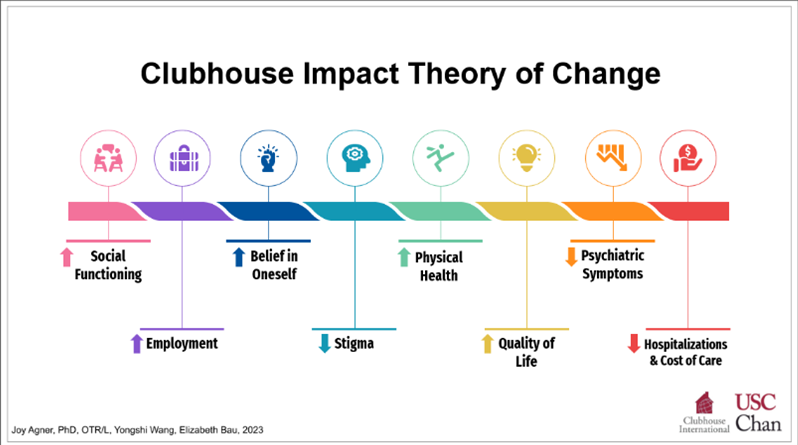
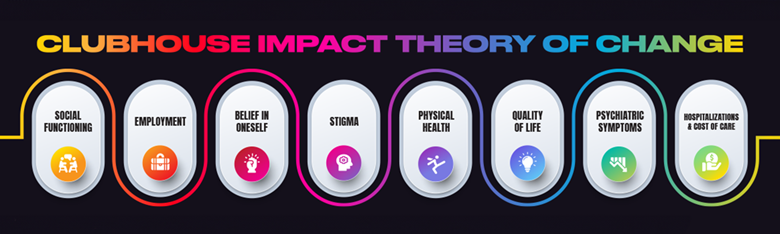
We are very pleased to introduce a new research tool for Clubhouses: the Transforming Lives: Clubhouse Impact Report summarizes the most compelling research on the Clubhouse Model. Click here to view a recent article about this new research. Created by Dr. Joy Agner and her team at the University of Southern California, this visual report integrates findings from 15 rigorous, peer-reviewed studies conducted between 1999 and 2021 into an integrated theory of change, depicted as follows:
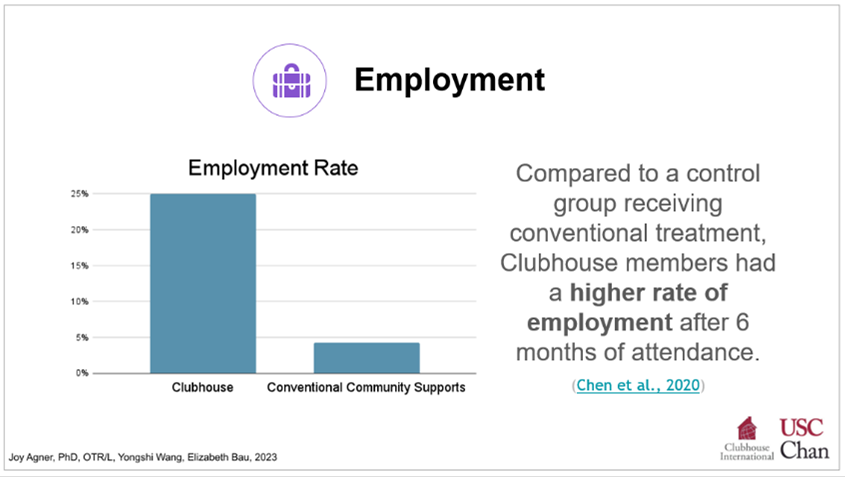
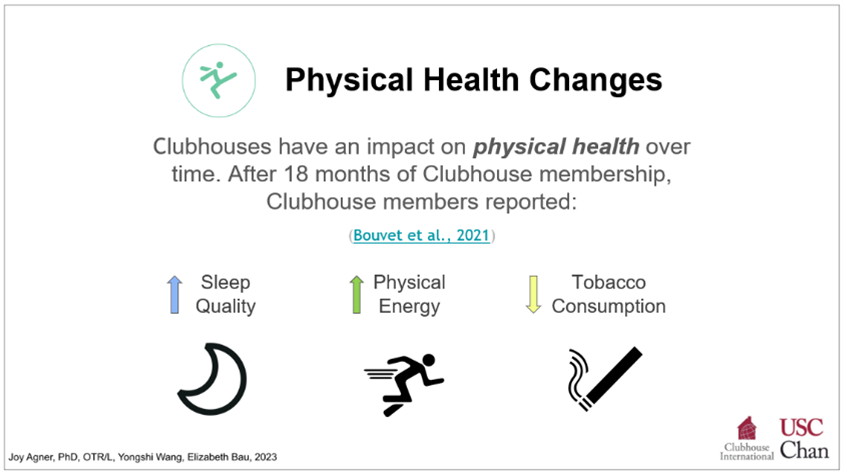
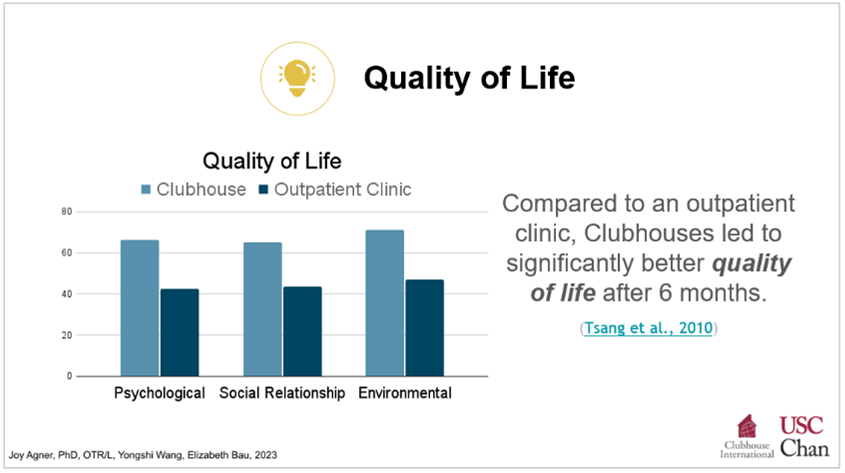
The presentations include individual slides that illustrate each area of impact, for example:
The purpose of the Clubhouse Impact Report is to increase access to high quality Clubhouse research in a user-friendly, visual, simple format. It can be presented to multiple audiences such as policy makers, fellow social service or mental health organizations, potential members, funders, or researchers planning a new study.
To enhance usability, we have created multiple versions that allow modification and tailoring. This includes:
A modifiable slide deck where the report can be augmented through member stories and personalized information. The slide deck includes speaker notes, additional study details, and suggestions for tailoring it.
Individual slide images that can be used as graphics in a report, on social media, or on other platforms to highlight a particular finding.
A standard pdf version that can be sent out in mailers or via email.
A detailed summary of included studies. For those seeking further information on included studies, the summary table has all measures, constructs, and findings at a much higher level of detail.
To access all of these resources, fill out this Interest Form and read the Rules of Use. For any questions or comments on the Transforming Lives: Clubhouse Impact Report please contact Dr. Joy Agner (agner@usc.edu) or Lee Kellogg (lkellogg@clubhouse-intl.org).
Clubhouses can also login to their Clubhouse International Portal account to view and download the customizable report, as well as a sample of the comprehensive slide deck that shows how it has been tailored by an individual Clubhouse. We encourage all Clubhouses to take advantage of this resource to promote their services and programs as a local Clubhouse, as well as a member of the Clubhouse International network.
Mobilizing Knowledge about the Clubhouse Model to Support People Living with Mental Illness
By partnering with a community organization, one USC Chan faculty member demonstrates how to engage a user base, develop a collaborative research agenda and put knowledge to work for the people who can most use it. Click here to view a PDF of this article.
By Katharine Gammon
Before she found Sheldon Clubhouse, life posed constant challenges for Leasa Holton. Managing mental illness led her to repeated hospitalizations over two decades. But discovering the mental health “Clubhouse” in her area, a place where she could go every day to work and socialize, was a game changer.
“I came into Clubhouse because it was a safe space for me,” Holton says. “I can do work here, be involved here, and I’m always welcome from the minute I come in, right until the time I leave.”
Clubhouse International is a non-profit organization that expands and enhances recovery opportunities for people living with mental illness using the proven Clubhouse Model of psychosocial rehabilitation. More than 360 Clubhouses in 32 countries around the world offer safe, welcoming environments in which people can work, socialize and actively participate in their own recovery.
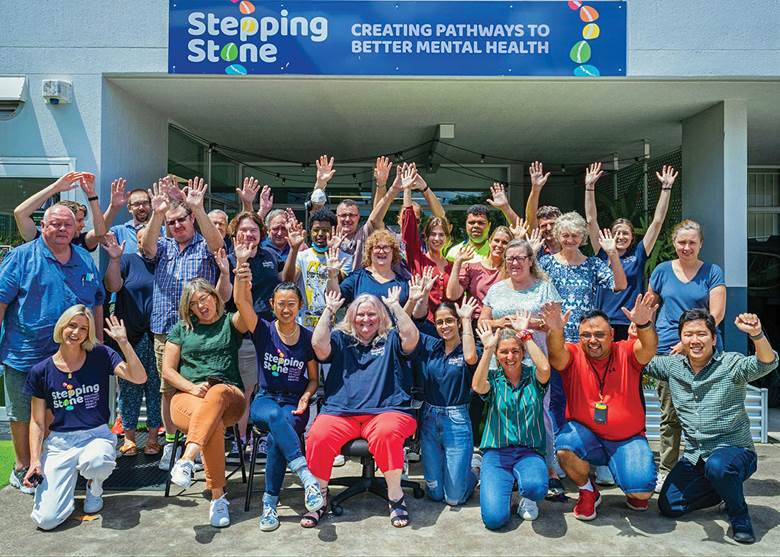
Clubhouse members at Stepping Stone, a Clubhouse International-affiliated organization in Brisbane, Australia, which describes itself as dedicated to suicide prevention and to ending social and economic isolation for people living with mental illness (photo courtesy of Clubhouse International).
Joy Agner, an assistant professor at USC Chan, specializes in community-based participatory research, working hand-in-hand with Clubhouse stakeholders, staff and members like Holton. CBPR empowers people to formulate the questions to conduct research that matters most to them.
But over years of collaboration, Agner has seen the gap between research about Clubhouses and organized efforts to increase its scale, advocacy and reach. While there’s ample research out there, she says, it can be frustratingly hard to access when locked behind paywalls or full of academic jargon.
So in addition to doing her own research, Agner and her student researchers Elizabeth Bau OTD ’25 and Yongshi Wang OTD ’23 put together a comprehensive review of the existing research literature about Clubhouses in a user-friendly, graphics-forward, customizable format. “Transforming Lives: Clubhouse Impact Report” integrates findings from 15 peer-reviewed studies conducted between 1999 and 2021. Agner and her team combined findings to create what she calls an “integrated theory of change” that explains how and why the Clubhouse Model works.
Clubhouse Impact Theory of Change (Joy Agner, Yongshi Wang, & Elizabeth Bau, 2023).
The report highlights the direct impact Clubhouses have on their members. For example, research shows Clubhouse members were much more likely to be employed after six months of attendance, as compared to individuals who received psychoeducation. Clubhouse members sustained employment longer than those who received assertive community treatment. Members’ quality of life was also much higher than individuals who attended an outpatient clinic, and those who sustained Clubhouse membership over two years reported fewer hospitalizations — which means lower total costs of their care.
Many people experiencing mental illness have nowhere to go during the day. Without occupations to engage in, they often report feeling isolated, separated from their community and stigmatized, all of which can cascade into a variety of other health problems. For people with existing health conditions, it becomes increasingly difficult to successfully manage their symptoms and care.
Clubhouses change that. At the center of it all, Agner says, is a community-based, purpose-driven approach.
“Our findings show that Clubhouses improve social connection and functioning,” she says. “They treat mental illness through community, and that community is developed through occupation.”
The model is relevant both for national efforts to reduce isolation and to treat mental illness, and it does so with a focus on occupation — what people actually do to occupy their time during the course of a day.
Included with the report is a modifiable, multimedia slide deck to help Clubhouses translate research into advocacy. Because it’s customizable, the slide deck can also highlight the personal journeys of Clubhouse members like Holton.
“It’s a way of repackaging this knowledge and leveraging it so that Clubhouses and their members can make actual impacts with it,” Agner says.
Moving the needle
Knowledge mobilization, sometimes shortened to “KMb,” describes the nonlinear, flexible process of knowledge generation, uptake and impact. The term is a rebuke to more traditional concepts portraying a linear, unidirectional “dissemination” of research flowing out of the ivory towers of academia.
To help conceptualize KMb, a team of USC Chan faculty developed a new visual model specific to occupational science and occupational therapy. It includes a four-phase process of generating, spreading, grasping and using knowledge, all of which is centered around stakeholders’ shared priority(ies). The phases interact in dynamic, fluid and unexpected ways, and yield impacts which can ripple within the contexts of people’s everyday lives.
Knowledge mobilization means getting research into the hands of people who can use it, including those making decisions about where tax dollars should go for different types of health services.
—Joy Agner
Agner’s work is a prime example of real-world knowledge mobilization — finding creative ways of driving evidence into action for those whose lives might actually benefit from it. Since being publicly released in February 2023, the report and slide deck have been accessed by Clubhouse members, staff and advocates in 33 states and 21 countries.
“Knowledge mobilization means getting research into the hands of people who can use it, including those making decisions about where tax dollars should go for different types of health services,” she says. “We also need to think creatively about how we can support this kind of work on a systems level, at USC and other places.”
Agner hopes that putting rigorous research into the community work that Clubhouses are doing actually moves the needle on funding. California’s Medicaid program, Medi-Cal, has proposed supporting Clubhouses in California through BH-CONNECT, a demonstration project that began in 2023 aimed at improving care of Medi-Cal members with significant behavioral health needs. At the federal level, U.S. House Rep. Ritchie Torres (NY-15) created the Congressional Clubhouse Caucus to advocate scaling up the Clubhouse Model nationwide. Taken together, reducing social isolation, raising mental health visibility and moving towards community drivers of health signal shifting public consciousness and attitudes, Agner says.
“People are looking at alternative models, knowing that a purely biomedical model is not working.”
Product development partners
The approach that Agner and her USC Chan occupational therapy students took in partnership with Clubhouse International was fundamental to their success, says Lee Kellogg, a program officer with the non-profit. By working with Clubhouse International’s research committee to solicit feedback and generate ideas, the relevant needs of all partners were woven into both the process and the final products.
“It’s really giving Clubhouses tools to speak more confidently and more articulately to their stakeholders,” Kellogg says. “Member stories resonate with stakeholders but they also need to see the evidence that Clubhouses work to get behind the funding, which makes the Clubhouse Impact Report a really valuable tool.”
Tying peer-reviewed data to members’ own stories can make them even more powerful, says Patricia O’Brien, with Clubhouse Coalition California.
“Joy [Agner] has an amazing level of insight and vision — she understood how people were going to need to use this material, and distilled it down to a level where really everyone can use it,” O’Brien says.
In the future, Agner is looking to gather more research ideas from the community and from her own work. Questions highlighted by members and staff focus on pinpointing factors that influence a Clubhouse’s success; how Clubhouse services influence housing outcomes; and the effects of Clubhouse engagement on caregivers, family and the broader community.
For Holton, the resources offered by her Clubhouse are vast: educational support, employment support, a culinary unit, phone answering and assistance with banking and money management. All of it, she adds, is designed to meet real needs within the community. For example, if a member is stuffing envelopes with papers, it’s not just to stay busy, it’s to send newsletters to friends and colleagues about the great things happening at that Clubhouse. In the end, she says, the occupation-centric aspect is what makes the Clubhouse Model unique. It’s also making a difference — Holton has not been hospitalized since she started coming to the Clubhouse.
“It’s meaningful work — it’s important, it’s not busy work,” Holton says. “And while doing that, I’m increasing my connections; I’m increasing opportunities to build meaningful relationships; I’m building skills; I’m having a sense of purpose — a reason to get out of bed.”
In this video, Clubhouse International’s Board Chair Jennifer Tedesco and Executive Director Joel D. Corcoran, and a number of our Clubhouse Founders, Directors and members themselves describe Who We Are: a global nonprofit organization working to end social and economic isolation for people living with mental illness through a network of over 350 Clubhouses in 32 countries. Supporting over 100,000 people a year, each Clubhouse provides their members with opportunities for recovery via employment, education, wellness and friendships.