Mental illness is now the leading cause of disability worldwide and society’s response to the urgent mental health crisis continues to be severely lacking. Mental illness accounts for 20% of the global burden of disease but only 3% of the world’s healthcare budgets are allocated to mental health needs, resulting in critical deficiencies in mental health care.
Mental illness pushes people to the margins of society to live an invisible, lonely, and desperate life excluded from friendships, education, employment, and community. The cost is immeasurable and the impact on the global economy is growing.
We invite conversations about how you can join this effort. Continue reading to learn more and get involved today.
A Demonstrated Solution: Clubhouse
The Clubhouse Model is a time-tested, evidence-based approach that provides opportunities for people living with mental illness to rebuild their lives.
Members in Accredited Clubhouses have higher rates of employment; a significant decrease in hospitalizations; reduced incarcerations; and better physical and mental health. The annual cost of Clubhouses is about one-third to one-half the cost of several other well-known psychosocial recovery models.
The Clubhouse Model is gaining recognition and support from mental health advocates and government agencies as an important part of the solution to the global mental health crisis.
The time is right to expand Clubhouse into many more communities.
A Recognized Leader: Clubhouse International
Clubhouse International is marking 30 years of successfully building and strengthening a worldwide network of Clubhouses for people living with mental illness.
Created to expand the number of Clubhouses worldwide and to lead the process of creating a quality assurance mechanism now called Accreditation, Clubhouse International is the only global leader helping to advance the Clubhouse Model as a community-based solution worldwide.
In the U.S. and around the world, we are the largest network of recovery-oriented programs for people living with mental illness and the only network of service providers that engages, first-hand, those with lived experience as a core organizational principle.
A New Plan for Growth
In recent years, interest in the Clubhouse Model has surged, leading to record training and support requests. To meet this demand, we’ve launched a strategic plan aimed at significantly accelerating the establishment of new Clubhouses.
Historically, we’ve grown by 5-6% annually, but with proper investment, we aim to double the number of Clubhouses in seven years and triple it in ten.
Our vision is to make Clubhouses as widespread and accessible as local YMCAs.
Organizational Priorities to Meet Growing Demand
To achieve our vision, we must make strategic investments in our organizational capacity and engage larger numbers of people and communities, in a variety of different ways.
Clubhouses are sophisticated opportunity centers and Clubhouse International provides the networking, education, training and advocacy to support that network. We have many initiatives in our new strategic plan that include wellness programming, data collection, research and more.
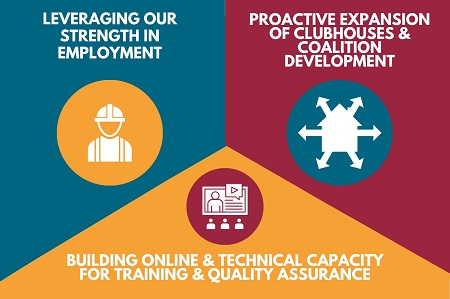
We have prioritized three focus areas that will have the most substantial impact on our ability to support the development of self-sustaining Clubhouses and improving local mental health systems for years to come.
Detailed plans for each of the three following elements are available upon request. To ensure success, we must also invest in enhanced communications.
Bringing Our Plan to Life
This strategic plan and vision will cost more than $13 million. We have program service revenue for a portion of it, but we need to raise $7.3 million in philanthropic support over the next three years. We have three specific needs to execute this plan:
Recruiting our next generation of board members. Referrals (or self-referrals) to potential board members is a critical component of our growth ahead.
Expanding our community of support. We are looking for introductions to others who would be interested in our work, particularly media and corporate leadership.
Individuals, corporations and foundations coming together to raise $7.3 million to achieve this vision.
The 30th Anniversary Campaign for Growth presents a unique opportunity for those committed to helping address the crisis in investment for mental health services and wanting to make systems-level change for people living with serious mental illness, in the U.S. and abroad.
We invite conversations about how you can join this effort.
Clubhouse International and our corporate partner, Otsuka, have come together in a three-year partnership to focus on improving employment outcomes for people living with serious mental illness by providing individualized support and expertise for at least 40 U.S. Clubhouses.
These Clubhouses have been identified as having poor or at-risk employment outcomes, where there was a significant loss of employment opportunities due to the pandemic; or where employment program structure and/or outcomes were identified as a key factor in the denial of full Accreditation; or for new Clubhouses that are just building their employment programs.
During the inaugural year of the employment project, we are pleased to share remarkable results. Amber Weber, our Employment Officer, works directly with Clubhouses and Coalitions across the U.S. to enhance employment programs, thus creating more job opportunities and helping to make the workplace more inclusive for people living with mental illness.
Here are several recent successes celebrated by our U.S.-based Clubhouses:
Wabash Clubhouse in Indiana obtained two Transitional Employment (TE)’s at a hospital and one Supported Employment (SE), all receptionist positions, and working out the details for a TE with their auspice agency.
Spring City Clubhouse in Wisconsin secured a TE and possibly an SE at Fresh Bowls.
Reclamation Clubhouse in Kansas developed a TE at a rehabilitation facility doing laundry and dishes.
Elev8 Clubhouse in St. George Utah, landed a TE at a local restaurant with substantial groundwork laid for an opportunity at Kohls.
A Michigan Employment Story:
Amber recently visited 11 Michigan Clubhouses to provide onsite support to strengthen their employment programs.
During her visit, one Clubhouse, Club Cadillac, invited a potential employer to tour the Clubhouse, which resulted in securing a new Transitional Employment partnership with a local bakery!
Amber also spent time with the Clubhouse discussing strategies to nurture this new partnership so that members can have an opportunity to work for years to come.
“Working at WildFlour means I get to meet more people than I already do, and it’s fun! Without the Clubhouse, I would not even know WildFlour was there, but now I get to work in a wonderful bakery. Working lets me do something other than staying home and makes me feel good about myself.” — Club Cadillac Clubhouse member, Hannah
Clubhouses Gain International Attention During U.N. General Assembly Gathering
As dozens of world leaders convened in New York City last week for the annual meeting of the U.N. General Assembly — Clubhouse International was pleased that CEO, Joel Corcoran, was invited to participate when Fountain House hosted Queen Mathilde of Belgium, and representatives of the World Health Organization (WHO) at Fountain House’s Manhattan Clubhouse. Fountain House also hosted First Lady of Estonia Sirje Karis. Click Here to View the Press Release!
Each guest spoke with members — all of whom live with serious mental illness — and were given a tour to see the inner workings of a Clubhouse and to learn firsthand the impact of the Clubhouse Model. Created by and for people living with serious mental illness, Clubhouses go beyond medication and therapy to leverage the power of an intentionally designed community to help people recover from mental illness. The Clubhouse environment represents a unique, holistic, and nonclinical approach to addressing the social symptoms and repercussions of serious mental illness that cannot be managed by medication alone.
Queen Mathilde and First Lady Sirje Karis each share a distinct interest in mental health with a focus on the well-being of youth in particular. The September 22 event — which was co-hosted alongside Clubhouse International — included a visit from Queen Mathilde and representatives from the WHO, who sat down for a conversation with members and staff in the Young Adult Connections Center (YACC), which provides support for people with serious mental illness ages 18-30. The First Lady of Estonia similarly met with members of YACC on September 23rd. During both meetings, members were given a chance to connect and share personal experiences and advice on what’s needed in today’s mental health care system.
Since 1948, the Clubhouse Model has significantly expanded internationally and has been replicated in nearly 40 U.S. states and in more than 30 countries around the world, which includes a Clubhouse in the city of Tallinn in Estonia. Clubhouse International is a global mental health nonprofit that helps communities around the world create sustainable solutions for mental illness. To date, Clubhouse International’s network has grown to over 360 Clubhouses worldwide.
“Fountain House was profoundly grateful for the opportunity to host mental health changemakers and public health experts from around the world,” said Ken Zimmerman, CEO of Fountain House. “We thank Queen Mathilde of Belgium, First Lady of Estonia Sirje Karis, and Dévora Kestel and Eva Kiegele of the World Health Organization for meeting with our community and for their deep commitment to mental health and bettering the lives of those living with serious mental illness. The potential of Clubhouses cannot be understated: Our model is uniquely positioned to dramatically improve people’s recovery and quality of life while providing tremendous economic savings and public health opportunities. We are excited by this opportunity to work together as a united front to expand global awareness of our holistic, proven approach.”
“It was an honor to meet Queen Mathilde of Belgium along with Dévora Kestel and Eva Kiegele of the World Health Organization, and tour Fountain House, the original Clubhouse in Manhattan and a leader in our Clubhouse International global network of 367 Clubhouse communities,” said Joel Corcoran, CEO of Clubhouse International. “Clubhouses are saving lives and fundamentally changing how we see and treat people with serious mental illness. We firmly believe that every single person with serious mental illness can lead a fulfilling, personally satisfying life by developing meaningful relationships, gaining access to opportunities for employment and education, and developing their talents, skills and hope for the future. This was a welcome opportunity to highlight the effectiveness and promise of the Clubhouse Model in making that a reality for more people around the world as we grow the reach and impact of our work.”
“My story is living proof that the Clubhouse Model is transforming lives,” said Aida Mejia, a member of Fountain House serving on Fountain House’s Executive Committee, who also led a tour during the events. “Being in a Clubhouse helped me to succeed when traditional mental health approaches were failing to provide what I needed. At Fountain House, I was given access to housing resources and work experience while also finding purpose and a community that authentically cared about my well-being. It was an honor and privilege to have international leaders and advocates at the Clubhouse, learning more about our personal experiences. My hope is that we can continue to open more Clubhouses globally so that people can benefit from the same life-changing resources that I was given.”
The Clubhouse community mourns the passing of Clubhouse icon, Ralph Bilby
It is with great sadness that we share the news of Ralph Bilby’s passing. Ralph was a beloved figure within the Clubhouse International community and beyond, renowned for his unwavering dedication to our cause. He tirelessly championed the creation of transformative programs for individuals living with mental illness, leaving an indelible mark on countless lives.
Ralph served as a compassionate leader and dedicated manager of Fountain House’s employment unit for many years and then as a senior staff person at Clubhouse International for 13 years. His passion for fostering partnerships between Clubhouses and employers was unparalleled. Ralph’s influence extended globally as he traveled extensively, training and supporting Clubhouse colleagues to strengthen Transitional Employment programs. Through his efforts, he created pathways to recovery and empowerment for many who otherwise would not have had such opportunities.
Beyond his professional achievements, Ralph played a pivotal role in shaping the Clubhouse International community. As a longstanding member of the Faculty for Clubhouse Development, he was a steadfast advocate for the potential inherent in every individual he encountered, whether member or staff. Ralph possessed a unique ability to inspire us to think ambitiously while setting goals that were both bold and attainable.
Ralph’s impact was far-reaching, his generosity in sharing his time, expertise, and encouragement having an exponential effect on the world around him. He was cherished by his colleagues, and his memory will continue to guide and inspire us in our ongoing work. We carry him in our hearts always. Go softly, dear friend.
Clubhouse International Celebrates 30 Years of Change
Clubhouse International, the only global non-profit, non-governmental organization that helps communities around the world create sustainable solutions for mental illness, celebrates the 30th Anniversary of its founding in 2024. Download our press release here, or browse our retrospective:
Joel D. Corcoran, CEO and Executive Director of Clubhouse International, marked the organization’s 30th Anniversary by acknowledging the dedication of the organization’s staff, supporters and many volunteers, and saluting the far greater accomplishments of the organization’s member Clubhouses:
“In 30 years, Clubhouse International has succeeded in creating something that didn’t exist before: a worldwide community that is changing the world of mental health. Through ongoing efforts to integrate the Clubhouse Model of psychosocial rehabilitation into community mental health approaches around the world, we are helping to end social and economic isolation for people living with mental illness. Our community offers people living with mental illness opportunities for friendship, employment, housing, education, wellness, and access to medical and psychiatric services in a single caring and safe environment – as they work towards recovery and personally satisfying lives.”
Today, Clubhouse International celebrates 30 years of success in:
Saving Lives Through Our Global Network of Clubhouses
We provide a bridge to recovery at over 370 Clubhouses across 31 countries reaching more than 100,000 members annually. According to available research, Clubhouses achieve the following tangible results for members and their communities:
Better transitional employment results: longer on-the-job tenure is found to be highly correlated with Clubhouse attendance.1
Cost effectiveness: at just $40 per member per day, the cost of Clubhouses is estimated to be one-third of the cost of the IPS model; about one-half the annual costs of Community Mental Health Centers; and substantially less than the ACT model.2
Reduced hospital stays: membership in a Clubhouse has resulted in a significant decrease in the number of hospitalizations.3
Reduced incarcerations: criminal justice system involvement is substantially diminished during and after Clubhouse psychosocial program membership.4
Improved well-being: Compared with individuals receiving services as usual, Clubhouse members have been shown to be significantly more likely to report that they had close friendships and someone they could rely on when they needed help.5
Expanding the Adoption and Effectiveness of the Clubhouse Model Worldwide
We ensure successful outcomes for members through Clubhouse Standards and Accreditation. Over the last 30 years:
Accreditation: Our unique quality assurance program is based on each Clubhouse’s adherence to the International Standards for Clubhouse Programs™, which includes providing ongoing technical training, mentorship and support. Today 70% of all Clubhouses worldwide are accredited.
Training & Seminars: Clubhouse International helps Clubhouses achieve sustainability through ongoing training and mentoring programs that support both new Clubhouse development and Clubhouse Accreditation.
Comprehensive Training: we maintain a network of 12 Training Centers located in the U.S., Canada, Europe, Asia and Australia. Since 1994, we have conducted over 3,500 training sessions for over 8,000 individuals
World Seminars & USA Conferences: We have hosted 15 World Seminars, 5 USA Conferences; training, connecting and engaging with over 11,000 participants.
Our signature New Clubhouse Development training: To date, we have supported 142 new Clubhouse Startup groups in 15 countries and have provided technical assistance and mentoring to hundreds more.
Achieving Increased Visibility and Acceptance of the Clubhouse Model
Through our partnerships with governments, healthcare providers, mental health advocates, foundations and corporations, and by reflecting the voice of lived experience, we work to broaden recognition of the Clubhouse Model. Recent strides include:
The Clubhouse Model was included in the US National Registry of Evidence-Based Programs and Practices—a major milestone for our organization.
In addition, Clubhouse International has received the following recognitions:
The 2022 Honorary Pardes Humanitarian Prize in Mental Health awarded by The Brain and Behavior Research Foundation.
The Special Presidential Commendation Award at the American Psychiatric Association (APA) 2021 Annual Meeting.
The $1.5 million Conrad N. Hilton Humanitarian Prize in 2014 (jointly awarded to Clubhouse International and our first, and largest Clubhouse, Fountain House NY).
Leveraging Resources
Well over $200 million a year in public and private funding has been provided to Clubhouses in support of people with mental illness.
Ending the Stigma Surrounding Mental Illness
Ending the stigma surrounding mental illness—through our coordinated advocacy efforts with local and regional Clubhouses and Clubhouse Coalitions, and engagement in social, government and mental health forums across the globe.
Corcoran concluded his remarks by saying, “We see a bright future ahead for Clubhouse International and the Clubhouse Model: a world where people living with mental illness everywhere can experience the respect, hope and opportunities found at Clubhouses. We look forward to a better world for mental health.”
Sources: 1 Macias, Kinney and Rodican (1995). 2 McKay, Yates and Johnsen (2005); IPS model reported by Clark et al (1998); ACT model reported by Macias et al (2001). 3 De Masso, Avi-Itzak and Obler (2001). 4 Johnson and Hickey (1999). 5 Warner, Huxley and Berg (1999). 6 Leff and colleagues (2004).
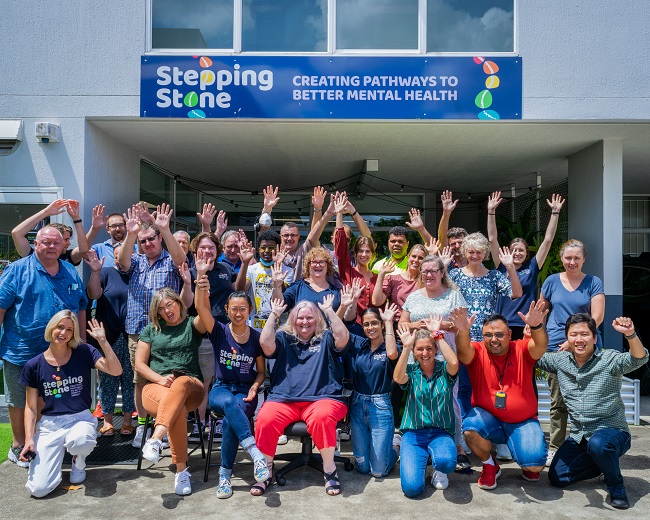
Tour Stepping Stone Clubhouse in Brisbane, Australia