


Clubhouse International Employment Programs are highly effective in helping people living with mental illness return to gainful employment, which is a gateway to recovery. Watch the video to learn more!
Author Archives: admin
Clubhouse International Employment Programs: Work WORKS!
04/03/25 | 0 comments
CEO Joel D. Corcoran Featured on PBS Broadcast During Mental Health Month
04/03/25 | 0 comments
The eighth season of Healthy Minds with Dr. Jeffrey Borenstein features Clubhouse International Executive Director and CEO, Joel D. Corcoran. The conversation focuses on the work of Clubhouse International providing accessible recovery opportunities for people living with mental illness around the world by integrating the Clubhouse Model into community-based systems of care. Click here to learn more.
Clubhouse International Calls for Support in Advancing Mental Health Initiatives
02/14/25 | 0 comments
Clubhouse International calls for partnerships and funding to achieve its mission of expanding the number of Clubhouses worldwide, providing hope and opportunity to more people with mental illness. Click here to view a PDF of this article.
New York, New York, Feb. 13, 2025 (GLOBE NEWSWIRE) –
Clubhouse International, a New York-based global nonprofit organization, encourages individuals and entities to join its efforts in delivering improved comprehensive mental health support through funding, advocacy, and partnerships. It shares its strategic plan to increase the number of Clubhouses worldwide over the next decade in hopes of proving that no one has to face mental illness alone.
Mental illness, despite being a leading cause of disability worldwide, lamentably receives an inadequate response to this day. Mental health awareness has grown, but creating sustainable solutions remains a challenge. Clubhouses emerge as an appealing option in helping individuals with mental illness regain control of their lives, serving as supportive spaces where they can find belonging, purpose, and opportunity.
Clubhouse International has spent over 30 years building and strengthening a global network of Clubhouses that serve as lifelines for people with mental illness. It employs the Clubhouse Model, which integrates opportunities for employment, education, housing, and wellness within a single supportive environment.
The Clubhouse Model is an evidence-based approach that has demonstrated success in improving outcomes for those with mental illness. Members of accredited Clubhouses experience higher employment rates, fewer hospitalizations, and better overall health compared to those receiving traditional mental health services. Mental health advocates and policymakers have acknowledged the model’s effectiveness, urging Clubhouse International to fight for more comprehensive, community-based mental health care.
The nonprofit’s efforts are recognized by acclaimed institutions. In 2021, it was honored with the Special Presidential Commendation Award by the American Psychiatric Association (APA), acknowledging the Clubhouse Model as a cost-effective, rights-based approach to recovery. The organization was also awarded the 2022 Pardes Humanitarian Prize in Mental Health by The Brain and Behavior Research Foundation, solidifying its vital role in mental health rehabilitation.
Aware of its massive impact in the space, Clubhouse International’s vision is to make Clubhouses as widespread and accessible as local YMCAs. It’s investing in infrastructure, partnerships, personnel, and advocacy efforts to turn its dream of ensuring that every community has a safe, supportive space for people with mental illness into reality. However, this ambitious expansion requires substantial funding and collaboration from various sectors. “We need partners who share our vision and are willing to invest in the future of mental health care,” says Anna Sackett Rountree, Director of Communications.
Clubhouse International has launched the Campaign for Growth to accelerate its expansion. With proper investment, it aims to establish new Clubhouses in underserved regions to ensure greater accessibility and improve training, accreditation, and operational support to maintain high-quality services. Advancing research and data collection and growing advocacy efforts are also included in the roadmap.
The organization prioritizes partnerships across the education, corporate, and healthcare sectors to achieve its goals. One of its most promising initiatives is its collaboration with academic institutions to integrate mental health awareness and support into educational settings. Clubhouse International has partnered with the University of Notre Dame through Active Minds, a student-led advocacy group focused on mental health. This partnership has already built a strong connection between students and local Clubhouses, providing opportunities to young people so they can engage in mental health advocacy.
Several Clubhouses partner with local universities to introduce students to the realities of living with mental illness. For example, one course, “Recovering from Mental Illness through Work and Community,” immerses students in the Clubhouse Model and encourages them to explore solutions for mental health challenges. “Programs like these open doors. Some of the students have become psychiatrists, have served on Clubhouse boards, or have contributed to mental health literature,” Anna proudly shares. “They’re now making a real difference in people’s lives.” With adequate funding, Clubhouse International would like to formalize the Clubhouse University Connection initiative.
Clubhouse International also engages with corporate partners to expand the Clubhouse Model. Through its Corporate Partners Program, companies can participate in mental health advocacy initiatives, employee education programs, and workplace inclusion efforts. Companies sharing the same vision have already joined, highlighting the initiative’s effectiveness.
The nonprofit’s efforts in integrating the Clubhouse Model into broader mental health systems are also underway. It’s expanding its psychosocial rehabilitation services in South Carolina, demonstrating how Clubhouses can complement traditional medical care.
Ultimately, all of Clubhouse International’s efforts are for the people—individuals who deserve dignity, inclusion, and opportunity. Mental illness is still stigmatized, making many people feel unseen or unheard. The organization changes lives by proving that recovery is possible and achievable for everyone. “We do this work because we believe in the power of community. Mental health is about connection, purpose, and hope, and everyone deserves that,” Anna stresses.
Clubhouse International’s Campaign for Growth represents one step forward in the fight for better mental health support. It welcomes funding, investments, and partnerships from individuals, corporations, and institutions that believe in its vision of making mental health recovery accessible to all.
Media Contact
Name: Anna Sackett Rountree
Email: asackett@clubhouse-intl.org
New Resource Helps Build Clubhouse Partnerships with Universities
12/11/24 | 0 comments
Introducing a new resource designed in partnership with Active Minds to help identify and strengthen partnerships between Clubhouses and local universities.
Check out the website and find a local Active Minds chapter near you! You’ll also find other helpful information, including:
- Outreach sample letter
- Grant-writing tips
- And so much more!
About the Collaboration:
Over the past few years, Clubhouse International has partnered with the Active Minds chapter at University of Notre Dame to advance understanding of mental illness and enhance community connections. Both Active Minds and Clubhouse International share a commitment to changing the narrative around mental illness. With a network of Active Minds chapters across the U.S., many of which are located near Clubhouses, this partnership offers great potential.
As part of this collaboration, we worked with Notre Dame to create a website that offers information to help Clubhouses build and grow similar partnerships with their local Active Minds chapters at colleges and universities. We hope this website will serve as a resource for establishing connections, sharing ideas, and fostering collaboration at the local level.
Examples of how Active Minds Notre Dame partners with the Clubhouse community:
- Grant-writing: Active Minds at Notre Dame worked closely with Lexington House, a Clubhouse in Elkhart, Indiana, to apply for the Institute for Social Concerns (ISC) Grant. This grant, offered by Notre Dame, supports research on the Clubhouse Model. The collaboration included weekly Zoom meetings where both groups worked together to prepare the grant, utilizing resources now available on the website’s grant-writing tab that other Clubhouses can utilize.
- Social Media: Active Minds Notre Dame partnered with Clubhouse Indiana to build its social media presence. By collaborating weekly, they helped create and launch an Instagram page for Clubhouse Indiana, which now shares valuable information about mental health and Clubhouse resources across the state.
About Active Minds:
Active Minds is a US-based nonprofit organization focused on changing and destigmatizing the conversation around mental health, with a focus on young adults ages 14–25. Active Minds has chapters in more than 1,000 college campuses and communities.
Why Every Community Needs a Clubhouse
12/10/24 | 0 comments
Chief Operating Officer, Jack Yatsko, joined Connections House’s podcast, Connected, to discuss how Clubhouses help strengthen and create opportunities for individuals and communities. Click here to view and download the full transcript!
This year has seen remarkable growth of the Clubhouse International network. We have grown to 371 Clubhouses in 32 countries!
Transcript Excerpt: Why Do You Think that Every Community Needs a Clubhouse?
Brianna: Jack, why do you feel like every community should have a Clubhouse?
Jack: Well, I think I’ll answer that in two ways. One is in more of the words of members. We refer the people who come to the Clubhouse as members, not patients or clients because they’re members of a community and they’re involved in the day-to-day operations of the Clubhouse and I’ve been to over 200 Clubhouses.
To answer that question in the words of many and visiting over 200 Clubhouses, I constantly meet Clubhouse members who tell me, my Clubhouse not only changed my life, it saved my life. We take those words very seriously in our work and those words are why every community should have a Clubhouse because it changes lives and saves lives according to the testimonials of so many different members.
The other aspect of that is Clubhouses are a value add to any community. Think of Boys and Girls Clubs, senior centers, Rotary Clubs. Not everybody knows exactly what do they do at the Rotary Club or what’s the programmatic components of the Boys and Girls Club but people have a general idea that these are good things and they add value to the community. So too does Clubhouses add value to the community for adults who’ve experienced some mental illness.
In that vernacular, while people think of every community needing senior centers and well-respected organizations like that, I too feel like if every community had a Clubhouse, because every community has people with mental illness but not every community has a resource center such as this, there’s value added to that.
And we’ll dive into more of that. I think the piece about like a broader conversation around the space around mental health is that we need to think of this more than just the treatment. People think, okay, get medication and get therapy or supports like that.
Those are very valuable components of many people who’ve experienced a mental illness but more so than that is the rehabilitation piece of that. Like, how do you know if you’re a treating psychiatrist and you’re seeing somebody once a month in your prescribing medication, like how effective that really is if somebody doesn’t leave the house and go out into the community? My mom had a really bad anxiety problem and one of the ways of measuring that was could she get out of the house and interact with people?
If she’s just staying behind the four, the sanctity of the four walls of her house, that medication may be helpful to keeping her out of the hospital but is it really helping her or anybody else to get out the doors and go to the grocery store, go to the movies, to have a life? Right. And that’s what Clubhouses do.
So really Clubhouses are a bridge for people to reintegrate back into society. So we very much complement regular psychiatric treatment and other treatment components that are out there. So really it’s like say, I don’t know, another comparison might be if you have to get a knee replacement for example.
And so you get your knee replaced, the surgery is done, you get your knee replaced but if you don’t do the rehab and you don’t do the work and the exercise to get that functional, then that may not, you may not progress being able to use your new knee in the same way you did before. So same sort of thing with the psychiatric community, there’s so many much better medications, much worse, I mean much less of the worst side effects that sometimes came with older psychotropics.
That is really advancing which is a wonderful thing. But so too is the other rehab component. How is this really measuring and helping people with staying out of the hospital and reintegrating back into society through employment, school, housing and all those kinds of things. That’s what Clubhouse is the secret sauce of getting people back into their lives.
Much more is available! Click Here to Read the Full Transcript!
Support Today, Grow Tomorrow
12/10/24 | 0 comments
Learn how Clubhouses Help Members Thrive
This holiday season, please consider giving a gift that will help us open more Clubhouses around the world. Each Clubhouse supports members on their recovery journey.
This is a story about how a Clubhouse in California came to be, and how it’s already changing lives.
Diane Rabinowitz had tried for years to help her son, Tariq, who faced homelessness and incarceration after a mental health crisis at 17. She even relocated to a smaller town, where she became President of her local National Alliance on Mental Illness (NAMI).
“And one day I looked around and saw all these adults sitting around while volunteers cooked [in a local shelter]. I thought to myself: how are they learning to be self-sufficient?”
Through research, she discovered Clubhouse International and connected with Jack Yatsko, our COO.
Diane exchanged emails with Jack who advised her that the strongest new Clubhouses are formed with a small group of committed individuals from the community, what we call a Startup group. She quickly formed a group.
The Startup group attended our New Clubhouse Development (NCD) training where they put together a business plan, including strategies to secure community support as part of Clubhouse International’s process for establishing new Clubhouses.
Our process connects new Startup groups with experienced Clubhouse leaders, so Jack introduced Diane to Tamara Hunter, founding staff member of another Clubhouse located just over two hours away. Tamara became their mentor, while Diane had monthly check-ins with Jack and the program team for technical support.
The group had grown quickly, securing a location and starting to line up funding, when they encountered resistance from a neighboring business—a common NIMBY (not in my back yard) challenge faced by new Clubhouse groups.
“This was another point where Clubhouse International rose to help. They were able to connect me to other people who had successfully navigated the same issue in their own community.”
It took a year of persistence, but the group secured some important local funding and overcame community resistance. Finally, after two years of hard work, Clubhouse El Dorado had their grand opening this past September.
We all celebrated Clubhouse El Dorado’s opening. Today, less than three months after opening, they are already meeting their initial membership and daily attendance goals!

We now have more than 370 Clubhouses in our global network. We are working to increase that number every day, so no community is without a Clubhouse. That’s our vision. And your support can make it happen.
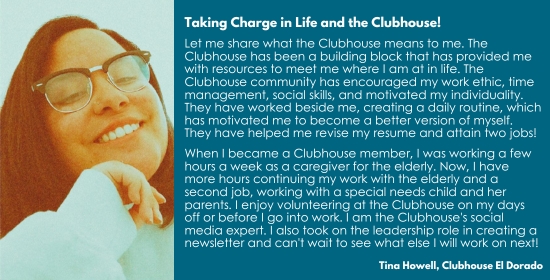
Tina’s story above is only possible because Diane’s story was possible. Your gift will make more of these stories possible! Please make a gift today.